
Identify Who Owns an Early County Property
Early County parcel ownership is a two-record task. The assessment roll gives a quick owner-of-record lead, while the newest deed names the recorded grantee and transfer date. Start from the known address, hold onto the parcel number and legal description, and those facts keep the deed records tied to the same land.
- Open the Early qPublic entry and locate the parcel by a supported address, owner, or parcel route.
- Save the exact owner string, parcel number, situs, and legal description shown.
- Search the GSCCCA Real Estate Index for the newest deed affecting that land.
- Compare the deed's grantee and recording date with the certified-roll name.
- Resolve a company through Georgia's business search or an estate through the proper probate record.
Trace Early County Property Addresses
The Early County qPublic acceptance page is the assessor's official entry point. It states that its data comes from the last certified tax roll. The Schneider application behind it sometimes blocks public sessions. Its field labels and result layout can vary on the live screen. Confirm any platform option exists before relying on it.
A street search sometimes comes up empty. Try a highway form, a directional variant, a road abbreviation, an old road name, or the legal description. Rural instruments may instead list land lot, district, acreage, a railway, or adjoining owners. They may not use a modern situs address at all. An E-911 point helps locate an address but proves no parcel line.
The qPublic notice documents the official starting gate for this owner-finding method.
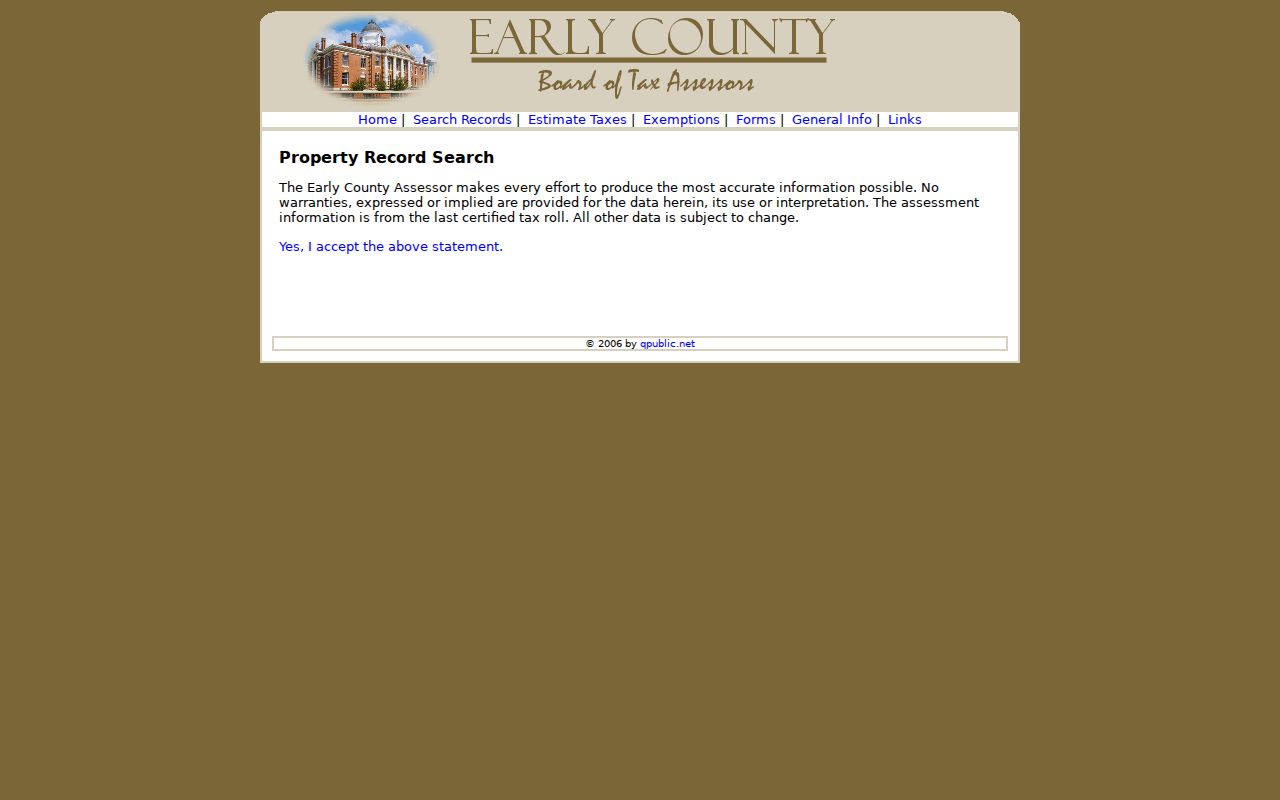
Note: The roll's own disclaimer is why every answer should include the date checked plus a deed confirmation.
Use Early County Ownership Prefixes
Early County's Code Enforcement guide pairs the letter A with Arlington. It pairs B with Blakely. D goes with Damascus, and J with Jakin. A tax-map parcel that starts with a number signals unincorporated county land for this routing purpose. The prefix can steer a later permit or zoning request to the right office.
Treat the prefix as a routing clue, not a survey or a statewide APN rule. Arlington spans both Early and Calhoun Counties. So an Arlington address still needs a county check before an Early property record counts as the answer.
Sources for Early County Property Owners
Each source answers a different part of the question. Joining them is safer than treating any single name as complete proof.
| Source | Owner Info It Gives | Access |
|---|---|---|
| Early qPublic roll | Parcel and tax-roll owner lead | County assessor entry |
| Clerk / GSCCCA | Newest recorded deed and grantee | Online index or clerk-office database |
| Georgia SOS | Public company identity and agent details | Official business search |
| Probate records | Estate or representative authority | Early County Probate Court |
The owner of record, taxpayer, mailing recipient, trustee, permit applicant, registered agent, and occupant can all be different people. Keep those roles separate. A mailing address only shows where notices go, not that the named person lives on the parcel.
Trace Early County Owners to Deeds
The Early County Clerk of Superior Court records deeds. The office sits at 111 Court Square, Suite C, Blakely. GSCCCA offers name and book/page searches, with property and premium modes as extra routes. Use the exact owner string. Then inspect the newest relevant conveyance for the grantee, recording date, and matching legal description.
A limited-use online account can show index summaries. But images and printing carry separate account terms. Any Georgia Superior Court clerk's office provides free database access. The earliest Early County online year and the local certified-copy charge are not published online. So call the Clerk at (229) 723-3033 when the index or image route leaves the question open.
Identify Early County Entity Owners
The Georgia Secretary of State Business Search offers fields for business name, control number, registered-agent name, officer name, and designated-agent name. Search the deed's exact grantee string, then test punctuation and suffix variants. The results can distinguish similar companies.
This is not a beneficial-owner database. A registered agent is a service contact, not proof of land ownership. A trustee may hold the deed while the trust terms stay private, and an estate may need probate authority before any distribution deed records.
Continue an Early County Owner Search Offline
Some parcels defeat the online app. Ask the Board of Tax Assessors for the existing parcel record instead. Offer a situs, parcel number, or legal description. The Clerk's deed room comes next. There you can search the grantee index and chase any prior book and page reference. Plat books matter too, because a split, combination, or subdivision can change a parcel's identity.
Older gaps call for different sources. Tax digests, probate material, microfilm, and the Early County News often hold names and recording clues. Newspaper notices are pointers. They lead toward the official record but never replace the instrument itself.
A Georgia Open Records request is another fallback. It applies when an agency holds an existing parcel, permit, or mapping record that is not published online. Address the written request to the proper custodian. Describe the record instead of asking for an investigation. Provide a parcel number, date range, or legal description. State guidance allows charges for lawful search, retrieval, redaction, and copying. Ask for an estimate when the file may be large.
Match each office to its purpose. The Board of Tax Assessors keeps the assessment roll, while the Tax Commissioner handles bills and payments. The Clerk records deeds, liens, and plats. Permits split by jurisdiction. County Code Enforcement handles unincorporated permits, and Blakely offers a municipal permit route. No office should be asked to certify a conclusion outside its own records.
One caution on addresses. A postal city does not prove incorporation. An Arlington mailing line also does not prove the parcel lies in Early rather than Calhoun County. Confirm the county and jurisdiction before accepting the assessor and deed route.
The Fire and Early County Owner Records
The Georgia Archives card for Early County records a courthouse fire in 1896. Chains crossing that era need extra sources. Surviving deed books, the County Records Microfilm Index, tax digests, estate papers, and later deeds that restate earlier references can together reconstruct a lead. Honest reconstruction beats pretending a missing original survives.
Test Early County Owner Results
Write everything down as you go. Log the qPublic access date and the certified-roll warning. Record the exact parcel number, the owner string, the situs, and the legal description. Then add the newest deed's grantee, instrument type, recording date, and book and page. Mismatched names may just reflect timing. If the dates explain the change, note it; if the land descriptions differ, stop and resolve the parcel identity before going further.
Permits, tax bills, registered-agent records, and probate filings clarify roles, but none replaces the deed. A permit applicant may not own the land. A tax mailing recipient may live elsewhere. A probate representative may hold authority without receiving the parcel, so state plainly what role each record proves.
Some addresses are withheld for good reason. Respect the custodian's redaction decision. Georgia Safe At Home and VoteSafe exist to shield qualifying people, and public-record research never justifies reconstructing a withheld location.
An estate name raises its own question. Check whether the deed still names the decedent. Or check whether a personal representative has recorded a later transfer in Early County. Probate authority and ownership are related but separate facts. A probate order can authorize an act without ever updating the deed index. A distribution deed still has to match the parcel description.
Trust ownership calls for restraint too. A recorded deed may name a trustee and identify the trust by date, while the full trust agreement stays private. Report the trustee and vesting exactly as recorded. Never infer beneficiaries, family relationships, or residence from the mailing line.
Company-owned parcels in Early County add another layer. Search the Georgia business record as of the relevant date. Entity status, formation date, principal office, and registered agent can separate similar grantee names. None of it proves beneficial ownership or the signer's authority. The deed plus any recorded corporate or probate authority remains the property evidence.
Title questions may reach past the newest deed. Security deeds, cancellations, easements, liens, lis pendens, tax fi.fa. records, and court orders can affect an interest. They can do so without changing the assessor's displayed name. This method identifies the recorded party in Early County property records; it does not certify that the interest is free of claims.
Limits of Early County Property Ownership Records
The method identifies names in Early County property records. It does not establish occupancy, beneficial ownership of a trust or company, the absence of liens, or clear title. A tax map is not a survey. A deed index is not a legal title opinion. Quiet title, probate, foreclosure, lien priority, and boundary disputes belong with a Georgia attorney or title professional.
Lawful use. Use ownership records for genuine parcel research, and never harass, expose, or try to defeat Safe At Home or VoteSafe protections.