
Read Early County Deed Records
Every recorded deed starts as a conveyance. It is filed with the Early County Clerk of Superior Court. Once recorded, it names the parties and fixes a recording date. It also carries the legal description plus references to earlier filings. Together those details form a strong public trail. The legal effect, though, still depends on the instrument itself and the surrounding title record.
| Deed Type | What It Does | Common Use |
|---|---|---|
| Warranty deed | Conveys the stated interest with covenants expressed in the instrument | Ordinary arms-length transfer |
| Quitclaim deed | Conveys whatever interest the grantor has without broad title assurances | Family transfer or correction work |
| Security deed | Secures a debt against real property | Loan and later cancellation research |
| Administrator or executor deed | Conveys under estate authority | Probate-related transfer |
| Tax deed or deed under power | Records a transfer following a statutory sale process | Tax-sale or foreclosure chain |
An ownership deed rarely sits alone. A security deed, lien, release, easement, covenant, correction deed, or plat may share the same docket space. Follow every reference the parcel needs. One index row is never the whole title history.
Early County Deed Recorder
In Georgia, the Clerk of Superior Court serves as the recording office for deeds. For Early County, that clerk is Gayle Anderson, reached at 111 Court Square, Suite C, Blakely, GA 39823, or by mail at P.O. Box 849. The phone number is (229) 723-3033, the fax is (229) 723-4411, and email goes to gayle.anderson@gsccca.org. Copy requests for warranty deeds should be directed to the courthouse deed room.
The clerk keeps deed, lien, and plat dockets and can provide certified copies. Call ahead to confirm public-counter hours, payment methods, copy fees, and email-request procedures before visiting or mailing payment.
Search Early County Deed Indexes
The GSCCCA Real Estate Index allows searching by name or book and page. The service describes property and premium instrument-type options too. Its plat and lien systems each offer their own name or book/page routes. Be sure to select Early explicitly. The Pataula Judicial Circuit covers six other counties as well.
| Search control | Use in an Early County deed search | Limit |
|---|---|---|
| County | Select Early before running a party search | A broad name can otherwise return other Georgia counties |
| Grantor or grantee | Trace the transferring and receiving parties | Name variants and entities require separate searches |
| Book and page | Retrieve a cited instrument directly | Old books or images may require the clerk |
| Property or instrument type | Narrow a difficult result set | Some modes are premium; exact Early choices were not captured |
Open the official GSCCCA search landing page before viewing the captured service screen.
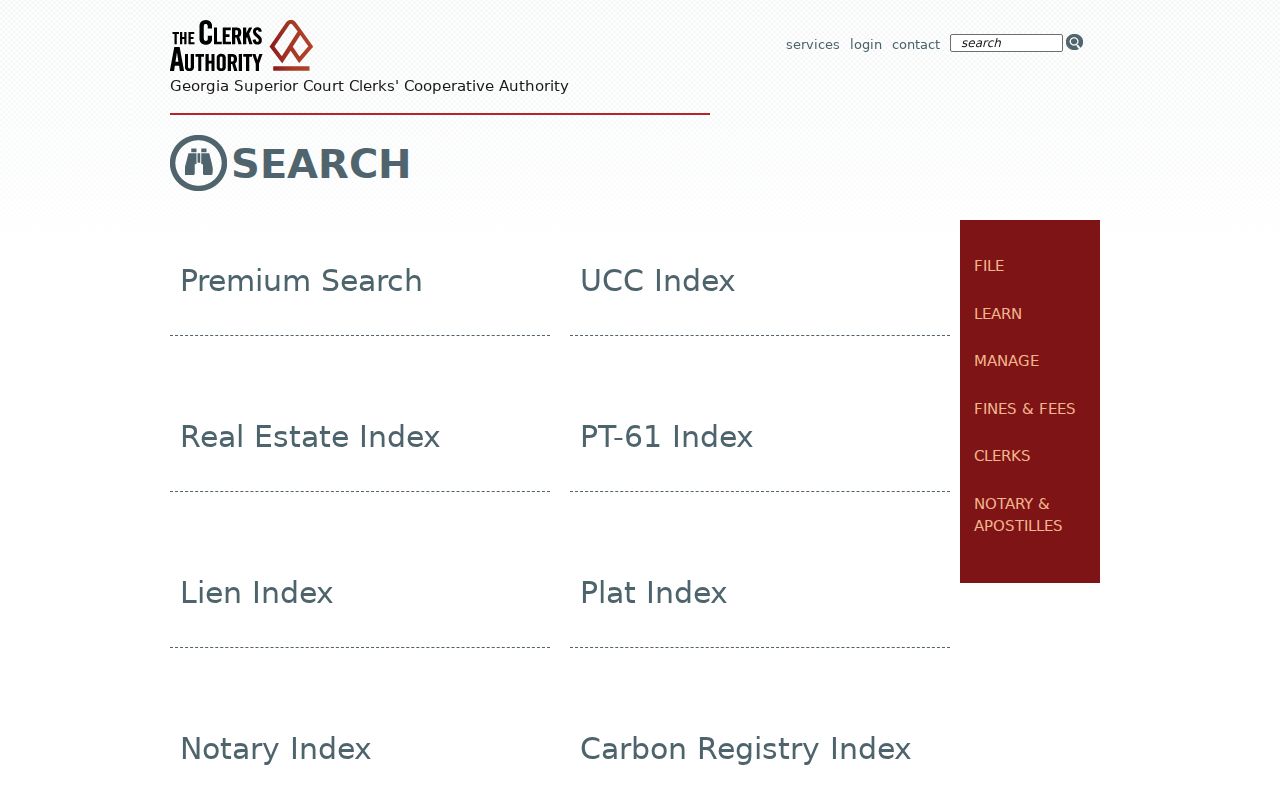
The statewide portal serves as the entry point. Its Early-specific earliest indexed year and current result controls call for a quick look before you rely on them.
Access Early County Deed Images
GSCCCA's account details separate free index summaries from document images and printing. Limited-use searching can surface summary information without images. Current posted pricing includes a four-hour single-use event at $5 plus printing. Online printed pages run $0.50 each. A regular monthly account costs $14.95, and a premium monthly account costs $29.95 effective July 1, 2025.
Free database access exists at any Georgia Superior Court clerk's office. Certified copies still carry their own charge, which Early County sets separately. Start with free name or book/page searching. Then pay only for the image or certification you actually need.
Walk Early County's Grantor-Grantee Chain
A backward chain treats each grantee's own acquisition as the bridge to the prior owner. Repeat that step deed by deed. Watch the legal description closely, since a lot split, combination, correction, or plat revision can shift what the same land is called.
- Find the most recent deed in which the current recorded owner appears as grantee.
- Read the grantor, recording date, legal description, and cited prior deed or plat.
- Search that grantor as an earlier grantee and repeat, testing the same land description at every link.
- Branch to probate, court, correction, release, easement, and plat records when a simple deed sequence breaks.
- At the online cutoff, ask the clerk and Georgia Archives about deed books or microfilm.
- Grantor
- The party named as transferring an interest.
- Grantee
- The party named as receiving an interest.
- Chain of title
- The connected sequence of instruments affecting the same land.
- Book/page
- A volume and page citation used to retrieve a recorded document.
Use Early County Deed Citations
Early County legal notices sometimes preserve unusually specific deed-record leads. One notice covers Arlington Hillcrest Heights. It identifies Lot 11, Land Lot 240 in the Sixth Land District, at Deed Book 92, page 303. A related tract covers two acres. It cites a June 14, 1979 survey and Deed Book 118, page 168. A Harrison Estate notice points to Parcel A006 025. It also cites Plat Book 2, page 167, and Deed Book 124, page 209. Another Arlington tract references Books 307 and 403, page 679. Treat these notices as search aids only. They do not replace the recorded images. Nor do they prove that similarly described tracts are one parcel.
Recover Early County Deed History
The Georgia Archives Early County card documents an 1896 courthouse fire. Any chain crossing that year needs a preservation check. Don't assume every deed burned or survived. Ask the clerk about surviving, burned, or re-recorded material. Also consult the County Records Microfilm Index.
Later deeds often restate an older chain. Tax digests, estate files, plats, and Early County News legal notices can supply party names. They can also supply land descriptions. A Damascus railway notice preserved a January 3, 1908 deed clue. It appeared, for instance, in a 1940 publication. Corroborate every clue against an official record.
Note: The earliest year of Early County's current GSCCCA online index is not stated.
Monitor Early County Deed Recordings
FANS is Georgia's voluntary notification service. It lets an owner or authorized person monitor indexed name, address, or document activity. It launched in 2023. A subscription runs for one year before renewal, and it depends on clerk transmission and indexing. Address alerts carry eligibility limits, and P.O. boxes do not qualify.
FANS looks forward only. It is not a title report or guaranteed real-time fraud detection. A suspicious alert should send you to the deed image. Check the prior deed, signature and notary details, the recording date, and any cancellation or court filing. Then go to the clerk and appropriate legal counsel.
Follow Security Deeds and Releases Separately
A conveyance deed and a security deed serve different purposes. A security deed secures a loan. Start with the borrower as grantor and the lender as grantee. Then follow any assignments and the eventual cancellation, release, or satisfaction. An index row that looks stale may simply hide a name variant. It may also hide an indexing slip, or a release recorded in a separate book.
The GSCCCA Lien Search offers name and book/page routes. It also offers a State Revenue Department route for pending liens. Search liens, judgments, lis pendens, and covenants separately. Before calling an index row active, record the filing date, claimant, and instrument reference. Record any release or disposition as well.
Easements and covenants can sit in the deed text or on a subdivision plat. They can also sit in a separate declaration. The assessor map will not show every private right. Pull every document the legal description cites.
Handle Estates, Corrections, and Parcel Splits
A tidy seller-to-buyer chain can break apart. Estates, trusts, court orders, correction deeds, and parcel splits interrupt it. For an estate, find the probate authority and the administrator or executor deed. Confirm that deed was recorded. A probate appointment alone never conveys the land.
A correction instrument is not a new arms-length sale, so compare its corrected names and description against the original deed. When acreage shifts, branch to plats and lot splits. A parcel number may not survive a split. Deed references and the land description then become the keys that keep ownership continuous.
PT-61 consideration can hint at a recorded transfer. But it may be nominal, exempt, incomplete, or tied to a nonmarket transaction, so keep it apart from the assessment value and from any present market opinion.
Verify Published Legal Notices Against the Image
The Early County News archive reaches back to 1859. It preserves foreclosure ads, sales, subdivisions, and tax notices. Search names, land lots, subdivision names, railroads, and exact book/page phrasing. OCR misreads surnames and numbers, so inspect the newspaper page image before carrying any citation to the clerk.
A notice only proves that text was published. It does not prove the sale closed, that the named borrower kept ownership, or that the tract matches a modern parcel. Use its parties, date, legal description, and instrument references. From there, follow later deeds, cancellations, or court dispositions in the Early County deed records.
Request an Early County Deed Copy
An online image suffices for a reference copy. For a certified copy, or for an instrument outside the online coverage, contact the Early County Clerk's deed room. Supply the county, instrument type, grantor and grantee, approximate recording date, book/page or instrument number, parcel number, and legal description. Say whether the copy must be certified.
Mail and in-person channels still matter for old deed books and uncertain indexes. Confirm hours, turnaround, payment, and postage with the office. Certification charges vary, so ask about those too. Keep the clerk's response with the copied instrument so its source and certification status stay clear.
Recorded, not guaranteed. Early County deed records show indexed filings, not every unrecorded interest or a legal conclusion about priority. A Georgia attorney or title professional must resolve title.
For an address-to-parcel starting point, use the Early County property search.