
Check the Early County Current Owner Record
Start with the Early County tax roll. The county's qPublic entry carries assessment data from the last certified roll. That timing matters. The name is the owner of record for that cycle. It is not a promise that no deed has arrived since certification. Copy the parcel number and the owner name exactly as displayed. Then take both to the Clerk of Superior Court. Compare them against the newest indexed conveyance for that parcel.
| Tax-roll owner | The person, estate, trust, or entity associated with the parcel on the certified roll |
|---|---|
| Parcel number | The local map identifier used to keep the search tied to the same land |
| Mailing address | The destination for assessment or tax correspondence, which may differ from the land |
| Situs address | The location of the parcel, when an address has been assigned |
| Legal description | The land identity used to compare the roll with a deed or plat |
| Latest deed reference | The recorded source used to verify the newest named grantee |
The owner field is not an occupant list. A mailing address tells you where notices go. The situs describes the property itself. A trustee, an estate representative, or a company can hold title while someone else uses the land, so read each field for what it actually claims. The live Early result card sits behind a verification screen, so its exact field labels may differ from what a written summary shows.
Why Early County Owner Names Can Lag
The Early County qPublic acceptance page states that its assessment information comes from the last certified tax roll. A sale recorded after that roll's cutoff can leave the former owner's name on the assessor record for a time. For a recent transfer, the latest recorded deed is the stronger date check.
Timing check. Record the date of the search and compare the tax-roll name with the latest deed's recording date before stating who owns now.
Route Early County Current Owners by Prefix
Local map prefixes offer a quick jurisdiction clue in Early County. The county guide links A with Arlington. B pairs with Blakely, D with Damascus, and J with Jakin. A parcel number that leads with a digit is treated as unincorporated for this first routing step. This shortcut never replaces a current boundary check. But it can keep a search from landing at the wrong permit office.
Arlington deserves extra care because the city straddles Early and Calhoun Counties. Confirm an A-prefix record sits on the Early side. Do that before trusting an Early County current owner result. For any parcel, keep the legal description beside the number. An annexation, a split, or a combination may have changed the identifier.
Verify an Early County Entity Owner
When the current owner is a company, copy the grantee string from the deed. Do not shorten it. The Georgia Secretary of State Business Search accepts a business name, control number, registered-agent name, officer name, or designated-agent name. It also offers Starts With, Contains, and Exact Match options. Its results can help distinguish similar entities and surface public entity details.
A registered agent is a service contact, nothing more. The agent is not proof of beneficial ownership. It may not be the person who controls the parcel. An entity's status likewise does not validate the deed itself. Match the legal entity name, the parcel description, and the recording date across the sources. Do this before settling an identity.
The state's official business search page displays the entity-search route. It also shows the query controls described above.
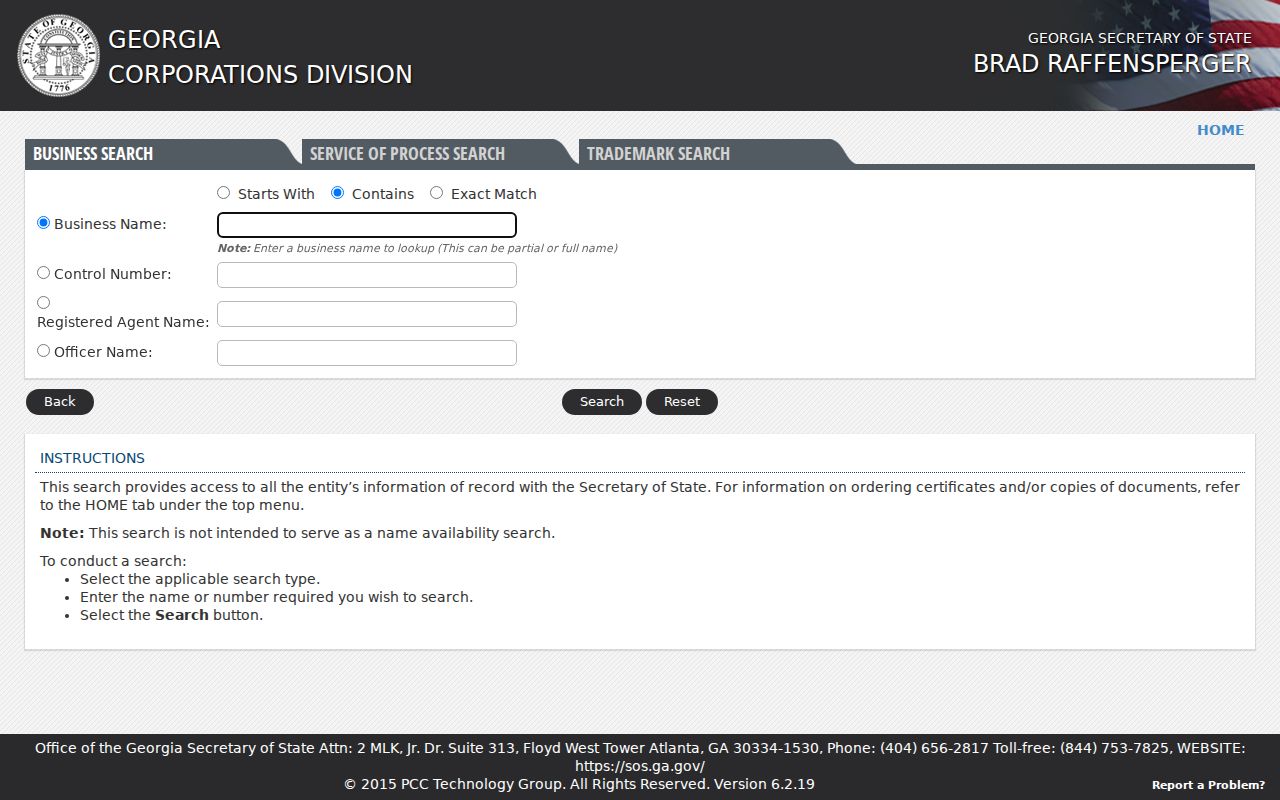
Use the state result as an identity cross-check, and keep the deed as the property evidence.
Confirm Who Owns Now in Early County
A solid present-tense answer pairs the Early County assessment record with the newest recorded deed instrument.
Keep each role separate. Work in this order:
- Open Early County qPublic, accept its data notice, and locate the parcel by a supported name, address, or parcel route.
- Save the displayed owner string, parcel number, legal description, and date checked without assuming the mailing address is the property.
- Search the GSCCCA Real Estate Index for the latest deed affecting that parcel and read the grantee and recording date.
- For a company, compare the exact deed name with the Georgia business record; for an estate or trust, identify the recorded or probate authority.
- Ask the Early County Clerk whether a newer instrument is pending or indexed when the dates or names conflict.
- Owner of record
- The party associated with ownership in the particular official record being read.
- Vesting
- The deed language that states how the grantee holds the conveyed interest.
- Tenancy
- The legal form in which two or more parties hold an interest, when stated in the instrument.
- Registered agent
- The public service contact for an entity, not a substitute for the deed's grantee.
Clerk Checks for Early County Current Owners
The Early County Clerk of Superior Court keeps the official deed records, liens, and plats. The office sits at 111 Court Square, Suite C, in Blakely. Through GSCCCA, searchers can run name searches and book/page searches. Property and premium modes are offered too. Viewing summary entries may require an account before images open. The Superior Court clerk's office, by contrast, takes a different approach. It offers free access to the database at the counter. Certified-copy fees are set locally, so ask before you order.
For a current-owner question, the latest deed matters most. So does any correction or later instrument that changes the grantee. A tax bill is not a title certificate. An index entry alone is not a title opinion either. Liens, probate authority, boundary defects, and competing claims can all complicate ownership. Reviewing the actual documents with a Georgia title professional is the safest course when stakes are high.
Each GSCCCA search mode earns its place. A name search works well when the assessor gives you a dependable owner string. Book/page search fits certain sources. A tax card, an older deed, a legal notice, or a plat can hand you a citation. Property and premium modes may open subdivision, lot, address, or map routes for participating data. Early County coverage has to be confirmed in the live system.
Account type shapes what you can see. Under current GSCCCA terms, a limited-use account reaches summaries but no images or printing. A single-use event runs four consecutive hours at separate charges. Monthly plans carry their own rates. Fees change over time. Confirm the current amount, including any local certified-copy charge, before you pay.
At the counter, bring more than a street address. Give the clerk the parcel number, the legal description, owner name variants, and a date range. Ask whether a newer deed is still pending indexing. If an instrument turns up, record its full type and reference. A deed, a correction, a cancellation, and a security deed each answer the owner-of-record question differently.
Early County Current Owners in Estates
An estate name in the owner field is a signal, not an answer. It tells you probate authority and a later distribution deed need checking. A trustee name works differently: the deed itself shows the holder. The private trust instrument may never become public. Neither label justifies guesses about heirs or beneficiaries.
Start with the recorded conveyance. Turn to Early County Probate Court records only for the authority that explains a transfer. If the chain includes a correction deed, a parcel split, or a new plat, match the legal description. Do not assume the old parcel number still covers the same land.
Names shift in the deed index. Punctuation, initials, suffixes, marriage, and entity conversions all create variants worth testing. Accept a match only when the parcel description and the dates line up. Two people sharing a name are not the same current owner. Both may appear in Early County records.
A permit file plays a narrower role. County Code Enforcement or a municipal office may list an applicant, a contractor, or a property contact. Those names can help route a question. None of them replaces assessor and deed evidence. And the absence of a permit never proves no work occurred.
Monitor New Early County Owner Filings
GSCCCA's Filing Activity Notification System offers a free, forward-looking alert. It covers an owner or authorized person. It can monitor eligible indexed name, address, or document activity. Requests expire after one year unless renewed. Registration alone does not create an alert.
FANS does not correct the current owner record. It guarantees no instant notice and replaces no title insurance. Name variants, an ineligible address, or clerk transmission timing can all affect an alert. A suspicious notice should lead straight back to the Early County Clerk. It should also lead back to the actual instrument.
Contacting an Early County Property Owner Lawfully
A public tax-roll mailing address may open a lawful route for a genuine parcel matter. It proves nothing about residence. Keep to the minimum public information needed for a purchase inquiry, easement question, boundary concern, or records correction. Georgia's Safe At Home and VoteSafe programs shield qualifying addresses. No search should ever try to defeat those protections.
Lawful use. Public owner data does not permit harassment, targeting, or exposing a protected person; contact the custodian about lawful redaction or confidentiality.